Before we get into this week’s Tip of the Week, we have some exciting news—the DAB Online Academy is now available as a monthly subscription, so your practice no longer needs to pay upfront.
Click the button below to visit the checkout page. On the left-hand side, you can explore every module and lesson before subscribing, so you know exactly what your team will receive.
Welcome to this week’s Tip of the Week and the next instalment in our implant and surgical series.
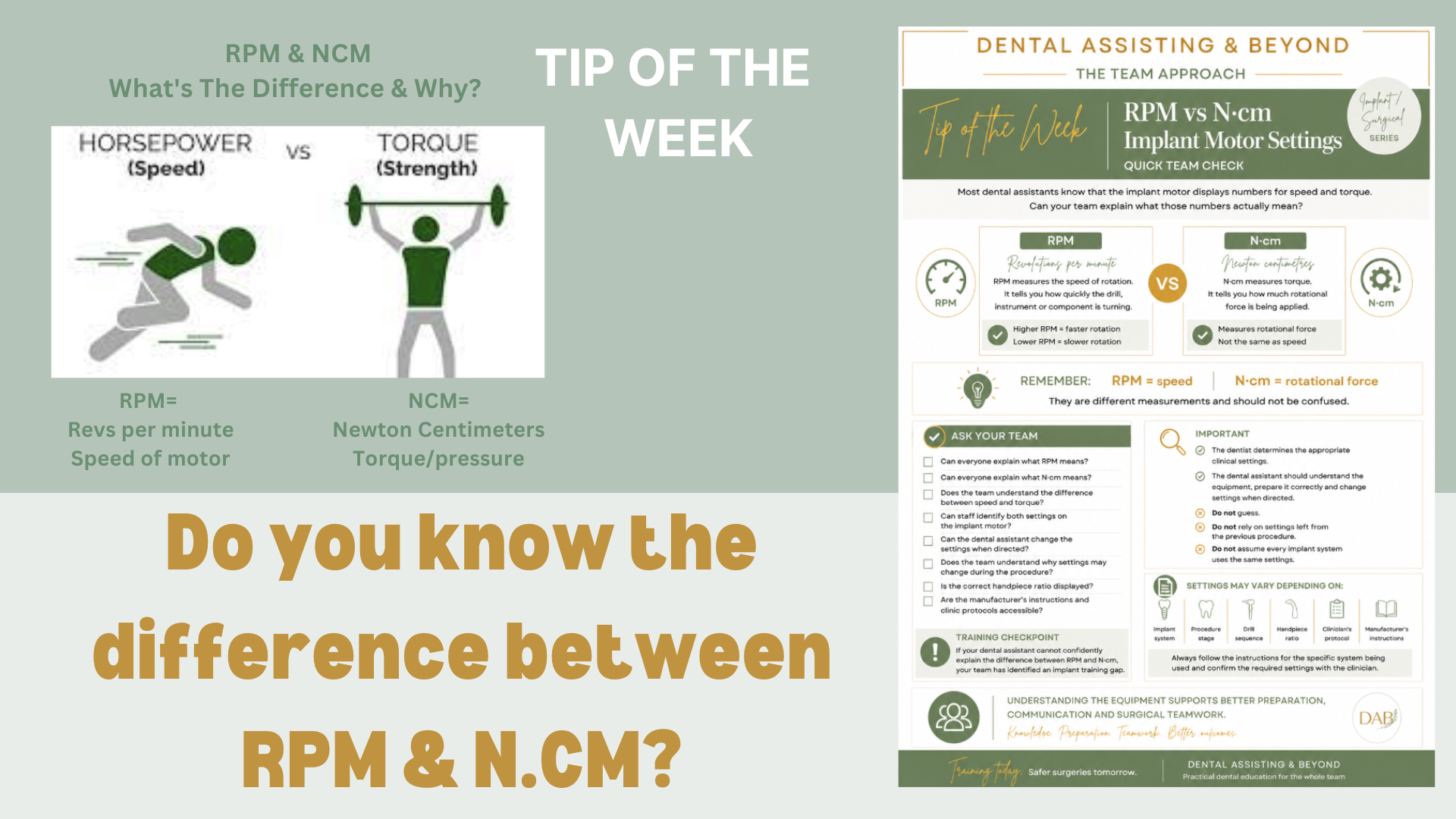
Most dental assistants know that the implant motor displays numbers for speed and torque. But can your team explain what those numbers actually mean?
When preparing for implant surgery, it is not enough to simply switch the motor on and wait for the dentist to adjust the settings.
A well-trained dental assistant should understand the difference between RPM and N·cm, where these values appear on the motor, and why the required settings may change throughout the procedure.
JOIN DAB ACADEMY FOR $95 PER MONTH PER PRACTICE. CLICK TO JOIN
Build stronger implant and surgical skills
Throughout this month, we are focusing on practical implant and surgical education for the dental team.
We are also looking at creating a new training bundle combining:
- Implant Essentials
- Advanced Surgical Skills
$750 + GST
Based on a combined standard price of $900 + GST, this would provide a saving of $200 + GST.
Explore The Implant and Surgical Bundle
The bundle would give dental assistants the opportunity to strengthen both their foundational implant knowledge and their understanding of more advanced surgical procedures.
Tip of the Week
The full tip and this week's free cheat sheet are subscriber-only. It's free to join, sign up now.
Understanding RPM and N·cm may seem basic, but these fundamentals support clearer communication, stronger preparation and more confident surgical assisting.
What do RPM & N.CM mean?
RPM stands for revolutions per minute.
It describes how quickly the drill, instrument or implant component is rotating
- Higher RPM means faster rotation.
- Lower RPM means slower rotation.
Different stages of an implant procedure may require different rotational speeds.